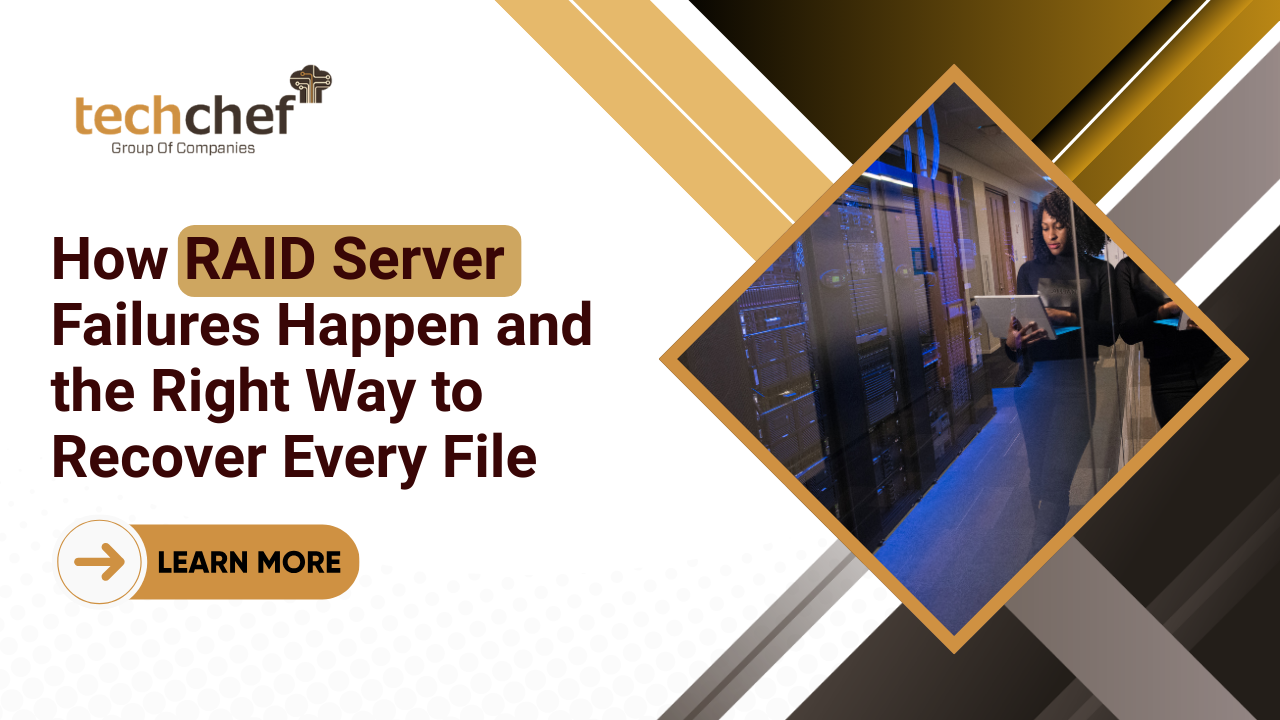
RAID server data recovery becomes a real concern the moment something unexpected goes wrong, because there are moments in our work life when everything feels smooth and predictable until one sudden failure shakes our confidence. If your RAID server has ever shown a strange error, slowed down unexpectedly, or dropped a drive without warning, then you already know that uneasy feeling in the stomach. You start wondering if all your business data is still safe. In those moments, we feel how important our digital world is. We feel how much we rely on our files, records, client data, financial history, and everything that keeps our business moving. That fear is real and very human. I have seen the same worry in the eyes of countless clients over the past 5 years.

Let me reassure you that you are not alone. RAID servers are designed to be reliable, but they are not perfect. Even the smartest technologies can fail when real world pressure hits. Sometimes the smallest warning sign is all it takes to prevent a serious collapse. But when those signs are ignored, businesses often end up needing Raid server data recovery, and that is usually more stressful and expensive than anyone expects. My goal in this guide is to make sure you feel prepared, aware, and confident enough to avoid those costly mistakes, while also knowing that help is always available if something goes wrong.
Understanding How RAID Servers Work
To understand RAID failures, we must first understand what keeps a RAID running. RAID uses a combination of striping, mirroring, and parity to store data across multiple drives. Striping spreads data across disks to improve speed. Mirroring duplicates data on two drives for protection. Parity stores mathematical information that helps rebuild data if a drive fails. Together, this creates a balanced system that improves redundancy and performance.
But even with these advantages, RAID is still vulnerable to issues that most people never think about. Many businesses assume that RAID alone can save them from data loss. This assumption often pushes them to depend on Raid server data recovery later when multiple failures occur together. RAID helps with uptime, but it does not magically protect against mechanical, electrical, software, or human mistakes. When one part fails, others become stressed and may follow the same path.
Common RAID Server Failures You Should Know
Understanding these failure types can help you act early and avoid unnecessary downtime.
A. Disk Drive Mechanical Failure
Every hard drive has a limited life. Over time, they wear out, develop bad sectors, overheat, or simply age beyond safe usage. When one drive fails in an array, a rebuild starts, and the remaining drives come under heavy load. If they are also old or weak, they often fail during the rebuild. That is when businesses urgently require Raid server data recovery to restore their files.
B. Multiple Drive Failure
RAID 0, RAID 5, RAID 6, and RAID 10 all have different tolerance levels, but multiple drive failures remain one of the most serious problems. Parity based arrays can collapse fast when more drives drop at the same time. The moment two or more disks crash together, the system becomes unreadable, leading to complex Raid server failure causes that need professional intervention.
C. RAID Controller Failure
The RAID controller is the brain of the entire array. Firmware corruption, battery backup damage, and cache errors can all cause the array to stop responding. When the controller fails, even healthy drives become inaccessible. This situation is one of the main Raid server failure cases that surprises many businesses because everything appears fine on the d
D. RAID Rebuild Failure
Rebuilds may fail due to wrong disk order, degraded disks, mismatched drive capacities, or inconsistent firmware versions. One wrong decision during a rebuild can create irreversible damage. That is why rebuild attempts without proper diagnosis turn into complicated Raid server data recovery scenarios in labs.
E. Human Errors
From accidental formatting to wrong disk replacement or using the wrong RAID level during rebuild, human mistakes are one of the biggest RAID server failure causes. As a consultant, I have seen many admins replace a healthy drive instead of a faulty one, making matters worse.
F. Power Surge and UPS Failure
Power surges, unstable electricity, and sudden UPS shutdowns can damage file systems and corrupt metadata. When parity information becomes inconsistent, the entire RAID array may stop mounting. Many Server recovery projects begin with power related faults that users did not even notice at the time.
G. Firmware or Software Corruption
Glitches in RAID BIOS, driver issues, or OS level corruption can cause the storage pool to become inaccessible. Even if all disks are technically healthy, RAID may fail to load properly. This leads to unexpected Raid server failure events that require careful reconstruction.
Warning Signs That Your RAID Server Is About to Fail
Many failures give early warnings, but in daily workload we often ignore the small signs that silently indicate serious trouble ahead.
Common warning signs include:
1. Frequent drive dropouts which mean one or more disks are repeatedly disconnecting from the array, indicating unstable health or poor communication between the drive and controller.
2. Slow read and write performance which shows the array is struggling to process data smoothly because one or more drives may be degrading internally.
3. File errors during access which point towards early corruption where the RAID architecture is no longer able to deliver clean and consistent data.
4. RAID degraded notifications which warn you that the array has lost redundancy and is currently running at risk without full fault tolerance.
5. Clicking, buzzing, or grinding noises which suggest serious mechanical damage inside the hard drives where the heads or platters are failing.
6. Growing bad sectors on drives which indicate the magnetic surface of the disk is deteriorating and the drive will soon become unreadable.
Ignoring these early signs often forces businesses into urgent and costly Raid server data recovery, which could have been avoided with timely action.
Why RAID Servers Fail Even When Drives Are Healthy
Sometimes the RAID server fails even though all the drives appear perfectly healthy, and this usually happens due to environmental, configuration, or operational issues that silently weaken the system over time.
Common causes include:
1. Heat imbalance inside server racks which happens when some parts of the rack become hotter than others, creating uneven thermal pressure that slowly stresses multiple drives at the same time.
2. Poor airflow or cooling which reduces the ability of the server to maintain a stable temperature, causing the drives and controller to overheat and eventually malfunction.
3. Drives installed from different manufacturing batches which results in uneven aging where some drives deteriorate faster, creating timing mismatches that disturb RAID stability.
4. Using low quality consumer drives in enterprise RAID which exposes the array to higher failure rates because consumer drives cannot handle continuous workloads, vibration levels, or 24 by 7 operation.
5. Scrubbing disabled for long periods which prevents the RAID from detecting silent data corruption early, allowing parity errors to accumulate until the array becomes unstable.
6. Heavy workloads beyond server limits which push the disks, controller, and cache to operate outside their safe performance range, eventually leading to operational failures in the RAID structure.
7. Unstable virtualization environments which place unpredictable load patterns on the RAID array, causing sudden spikes that the controller cannot handle consistently.
Even when the hardware seems flawless from the outside, these internal and environmental issues slowly build up and eventually lead to complete Raid server failure if not addressed properly.
How to Prevent Common RAID Server Failures
The best protection is prevention. With the right planning, monitoring, and maintenance, you can reduce the possibility of depending on expensive data recovery services.
A. Regular Drive Health Monitoring
✅ Use SMART monitoring tools
✅ Run predictive failure analysis
✅ Track drive temperature and vibration
Healthy monitoring helps you replace disks before they fail and keeps the array stable.
B. Correct RAID Configuration Practices
✅ Avoid mixing drive models
✅ Maintain uniform drive age and capacity
✅ Plan expansion carefully
Small configuration mistakes often result in large Raid server failure causes later.
C. Controller and Firmware Maintenance
✅ Update controller firmware regularly
✅ Check cache health
✅ Monitor BBU backup status
This reduces sudden controller crashes and ensures stable performance.
D. Environmental and Power Protection
✅ Use redundant power supplies
✅ Install UPS with surge protection
✅ Maintain proper server room cooling
Environmental care prevents a large number of hidden Server recovery scenarios.
E. Preemptive Strategies
✅ Enable RAID scrubbing
✅ Schedule parity checks
✅ Perform performance audits
These background processes keep the array healthy and reduce future risks.
F. Backup Strategy
Many people believe RAID is a backup, but that is not true. RAID protects against hardware failure, not accidental deletions, virus attacks, power faults, or human errors.
✅ Use local backups
✅ Use cloud backups
✅ Follow weekly or daily backup planning
Good backup strategies reduce dependence on Raid server data recovery during emergencies.
When You Should Stop and Call a Professional
There are certain moments when it is safer to pause immediately and allow experts to handle the situation before any more damage occurs.
1. The array stops mounting which means the RAID system is no longer able to read its own configuration and file structure, indicating a deeper internal failure that should not be forced with DIY attempts.
2. Rebuild attempts show errors which happens when the RAID system struggles to reconstruct data correctly, and pushing further can overwrite good data or permanently corrupt existing parity.
3. Multiple disks drop suddenly which signals a system wide breakdown where several drives lose communication at once, creating a highly sensitive condition that needs controlled professional handling.
4. Any drive makes clicking noises which is a clear sign of mechanical head failure inside the disk, and continuing to power it on can cause severe platter damage and loss of recoverable data.
5. Controller does not detect drives which indicates that the RAID controller’s logic, firmware, or ports are malfunctioning, and experimenting with cable swaps or resets can corrupt metadata further.
DIY actions at this stage usually make the situation worse and increase the overall complexity of data recovery, so it is always safer to reach out to a trained professional the moment you notice these warning signals.
How Professionals Recover RAID Servers Safely
Professional data recovery labs follow advanced, carefully controlled steps to restore your RAID server without causing any additional harm, ensuring every action protects your valuable data.
1. Drive by drive imaging which means experts create exact sector level copies of each disk using specialised write blocked tools so the original drives remain untouched and safe during the entire recovery process.
2. Metadata reconstruction which involves analysing the RAID’s structural information, including configuration records and parity details, to accurately rebuild the missing or corrupted layout that defines how your data was originally stored.
3. Mapping stripe size and parity rotation which allows the engineers to understand the exact pattern your RAID used to divide, store, and protect data across the drives, helping them accurately recreate the original array in a virtual environment.
4. Virtual RAID rebuilding which is the process of combining all imaged drives inside a controlled software environment where the array is virtually reconstructed without risking any physical damage or overwriting of real data.
5. Secure and controlled data extraction which ensures that once the virtual RAID is stable, the recovered files are copied safely to a new and healthy storage device, maintaining complete integrity, privacy, and consistency.
These proven and highly specialised methods help professional labs recover even the most complex RAID failures without risking additional Raid server failure, giving you the best possible chance of getting all your important data back safely.
Conclusion
RAID servers are powerful systems that help businesses stay efficient, but they are still vulnerable to real world risks. You and I both know how unpredictable technology can be. Even strong hardware can fail due to mechanical issues, controller faults, human mistakes, or electric damage. The best way to stay safe is to understand your system and take small preventive steps that save you from larger trouble later. When we treat RAID servers with care, we avoid unnecessary stress and maintain business continuity.
If your RAID server is showing unusual behaviour or has already failed, remember that help is never far away. Techchef has been supporting people across India with safe and trusted Raid server data recovery for years. You do not have to face data loss alone. Let experts take care of your server while you take care of your business. Sometimes all it takes is one phone call to feel confident and secure again.
👉 Visit: https://www.techchef.in/
We provide expert RAID server data recovery services across India with branches in Mumbai, Delhi, Bengaluru, and Chennai, ensuring fast and reliable assistance wherever you are.
Call us now for a free consultation at 1800 313 1737 and let us assist you in getting your precious data back safely.
FAQs
1. What is the most common cause of RAID server failure?
Mechanical drive failures and human errors are the most common RAID server failure causes.
2. Can I rebuild a RAID array myself?
It is not recommended. A wrong rebuild can overwrite parity and cause permanent data loss.
3. How long does RAID server data recovery take?
Most recoveries take between 3 and 12 days depending on the failure type and condition of the drives.
4. Can data be recovered if multiple drives fail?
Yes. With professional tools and manual metadata reconstruction, many arrays can still be recovered.
5. Does a power surge damage RAID servers?
Yes. It can corrupt controllers, file systems, and parity information, leading to serious failures.