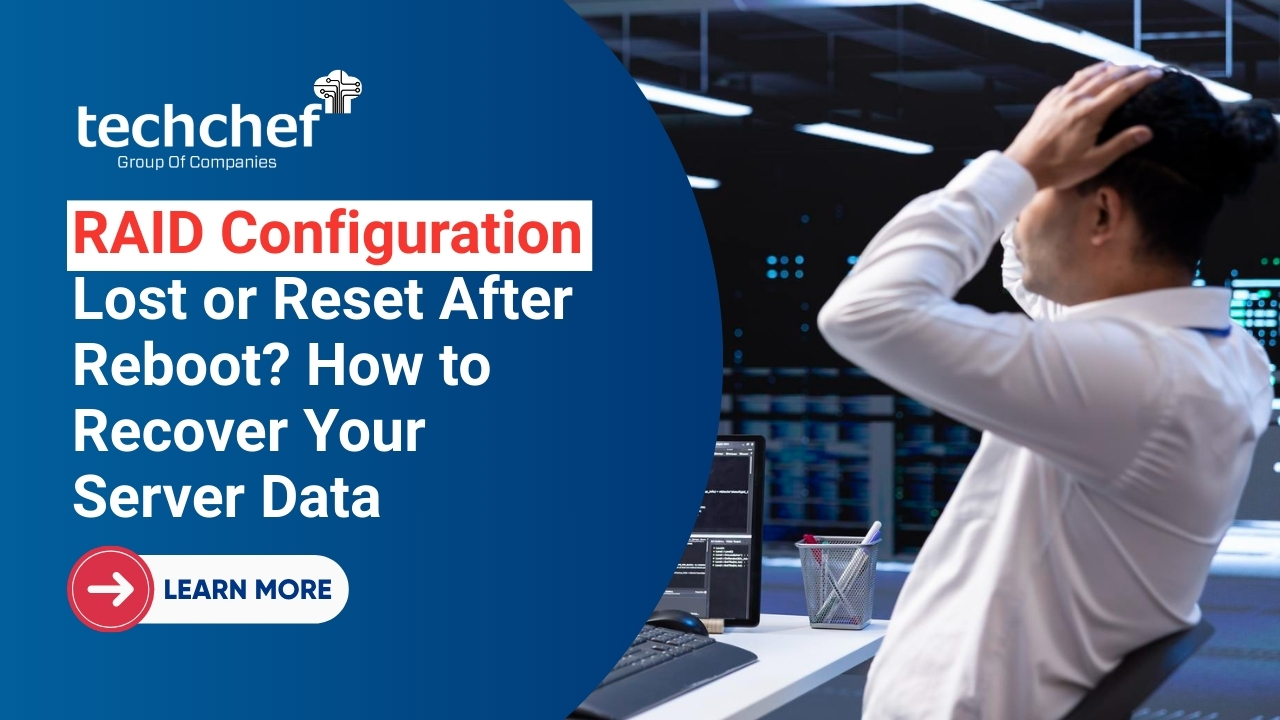
It usually starts as a routine moment. A planned reboot after updates, a power fluctuation late at night, or a system restart intended to clear minor performance issues. The server comes back online, but something feels wrong. Volumes are missing. RAID shows inactive or foreign. The familiar data paths no longer exist. Within minutes, dashboards light up, applications fail to load, and users start calling.
For many businesses, this is the moment panic quietly sets in. Years of operational data, databases, shared files, and virtual machines suddenly feel out of reach. Unlike a hard drive crash, this failure is invisible. Disks spin normally. LEDs look healthy. Yet the RAID configuration that once held everything together is gone. This is when RAID Server Data Recovery becomes not just a technical need but a business necessity.
What makes this situation especially dangerous is how deceptively normal it appears. Because the disks seem fine, administrators often attempt quick fixes. Rebuilds, reinitializations, controller resets, or firmware changes. Each of these actions can overwrite critical metadata that still holds the key to full recovery. Understanding what truly happened after that reboot is the first step toward saving your data.
How RAID Failure Feels Different From Other Server Issues
RAID failures trigger a very different reaction compared to typical server problems. With a single disk crash or accidental file deletion, the issue is usually visible and clearly defined. In contrast, a RAID configuration loss after reboot creates confusion because nothing appears obviously broken. The server powers on, disks spin normally, controllers respond, yet the data environment feels frozen. IT teams often describe this moment as unsettling because the system looks alive but behaves as if its memory has vanished.
As minutes pass, the impact spreads quickly across the business. Databases fail to mount, virtual machines remain offline, and critical applications report missing storage paths. Even backup systems may become unusable if they rely on the same RAID volumes. Decision makers begin asking for timelines while technical teams struggle to identify what changed during the reboot. This emotional pressure often leads to rushed actions that feel productive but quietly increase risk. In these moments, RAID Server Failure Recovery becomes time sensitive because every unnecessary scan, restart, or forced rebuild can overwrite configuration metadata that is still recoverable.
Did you know?
In many enterprise environments, RAID data becomes unrecoverable not because of the reboot itself, but due to automated background processes that rewrite metadata within the first few hours after failure.
Key Reasons RAID Configuration Gets Lost After Reboot
In most real-world cases, RAID configuration loss can be traced back to a small number of high-impact triggers. Focusing on these helps businesses understand what likely went wrong and why the data itself is often still recoverable.
- ✔️ Sudden power interruption during active operations
If a server shuts down unexpectedly while data or parity information is being written, RAID metadata may not be saved correctly. After a reboot, the controller may fail to recognize the array even though all disks are present and healthy. - ✔️ RAID controller firmware or hardware changes
Updating firmware or replacing a RAID controller without importing the existing configuration properly can cause the array to appear reset. The disks still hold data, but the controller no longer understands how they belong together. - ✔️ Interrupted rebuild or synchronization process
Stopping a rebuild midway leaves the RAID in an inconsistent logical state. After a restart, the controller may mark multiple disks as failed, making the configuration appear lost. - ✔️ Disk communication or timeout errors
Temporary delays or connectivity issues can cause drives to drop offline. When enough disks are flagged incorrectly, the RAID fails to assemble during boot. - ✔️ Human error during maintenance
Accidentally clearing configuration prompts or reinitializing disks is one of the most common causes. These actions erase RAID metadata while leaving actual data blocks untouched.
Each of these scenarios creates a situation where the RAID looks empty or reset, but the underlying data still exists and can often be restored through RAID Server Data Recovery when handled carefully.
Why Rebuild Options Can Be Extremely Dangerous
When a RAID controller flags an issue after a reboot, it often recommends a rebuild as the quickest way to restore access. Under business pressure, this option feels reassuring because it suggests the system still understands the array structure. In reality, a rebuild only works when every RAID parameter is perfectly intact. If the disk order, stripe size, or parity layout is even slightly incorrect, the rebuild does not repair the array. Instead, it starts writing new parity data over existing information, silently overwriting metadata and valid data blocks that are critical for RAID Server Data Recovery.
The risk increases significantly in parity-based arrays such as RAID 5. Because parity is distributed across all disks, an incorrect rebuild spreads damage evenly throughout the array. What makes this especially dangerous is that the rebuild may complete successfully from the controller’s perspective, giving a false sense of recovery. Files may appear, but databases fail, applications crash, and virtual machines refuse to start due to underlying corruption. At that point, recovery becomes far more complex because the original configuration data has already been altered, reducing the chances of accurate reconstruction.
The Right Way to Recover Data After RAID Configuration Loss
➜ Secure the RAID environment immediately
The first and most important step is stopping all activity on the server. Write operations, background synchronizations, and automated rebuild processes must be disabled at once. Continuing to run the system can silently modify disk metadata and parity information. Securing the environment ensures the original data state is preserved, which is essential for any successful RAID Server Data Recovery effort.
➜ Preserve each disk through sector level imaging
Every drive in the RAID array is cloned sector by sector to create exact replicas. This process captures all data, including system areas and fragments not visible at the file level. Recovery work is always performed on these cloned images, never on the original disks. This approach eliminates the risk of accidental overwrites and allows multiple recovery attempts without further damage.
➜ Reconstruct the RAID configuration virtually
Instead of rebuilding the array on the server, specialists recreate the RAID structure in a controlled recovery environment. Disk order, stripe size, parity rotation, and offsets are carefully identified and tested. Virtual reconstruction avoids guesswork and prevents the destructive writing that occurs during live rebuilds. This step is the foundation of accurate RAID configuration Data Recovery.
➜ Restore file systems and verify data integrity
Once the RAID logic is correctly rebuilt, the file system is repaired and analyzed. Folder structures, permissions, and application data are validated to ensure usability. Databases, virtual machines, and business files are checked for consistency before being extracted. This final step ensures recovered data is complete, functional, and ready for business use rather than partially restored or corrupted.
Did you know?
When RAID recovery follows a structured, non destructive process, most configuration-related failures are recoverable even if the array appears completely lost after reboot.
How NAS Environments Make RAID Failures More Complex
NAS based RAID failures are far more complicated than those seen in standard servers. In a traditional RAID server, configuration data is often stored clearly on the controller and disks, making analysis more straightforward. NAS environments work differently. They rely on proprietary operating systems, customized RAID logic, and vendor-specific metadata layers that are not visible through standard tools. When a RAID configuration is lost inside a NAS system, the problem is not limited to missing disk order alone. The entire storage logic, including volume mapping and share folder structure, can become unreadable at once.
Another major challenge is that NAS devices abstract RAID details from administrators. Disk order, parity placement, and system partitions are often hidden by the NAS interface. When a failure occurs, the NAS may simply show empty volumes or inaccessible shares without revealing what actually broke. File systems used by NAS devices are frequently customized or tuned versions of Linux based formats, which adds another layer of dependency on correct metadata. This is why incorrect actions like swapping drives, resetting the NAS, or applying generic RAID fixes can quickly overwrite critical information.
Because of these complexities, NAS Server Data Recovery requires a very different approach compared to standard RAID recovery. Specialists must first understand the NAS brand architecture, how it stores RAID metadata, and how system partitions interact with user data. Recovery tools must interpret vendor-specific structures without altering them. Attempting recovery without this understanding often damages proprietary metadata, making reconstruction far more difficult and sometimes impossible.
Did you know?
In many NAS failures, user data remains fully intact on disks, but recovery fails simply because vendor specific RAID metadata was altered by improper troubleshooting.
Why Backups Often Fail During RAID Configuration Loss
Backups give a sense of security, but during RAID configuration loss, they often fall short of restoring full business operations. Below are the most common reasons explained clearly and practically.
- 1️⃣ Backups depend on the same RAID structure
In many environments, backup systems pull data directly from the RAID volumes. When the RAID configuration is lost or reset, those backups become inaccessible or incomplete because the source storage itself cannot mount correctly. - 2️⃣ Backups are not always up to date
Scheduled backups may run daily or weekly. If the RAID failure happens between backup cycles, recent transactions, emails, databases, or files are permanently missing. This gap can translate into serious operational and financial impact. - 3️⃣ Lack of application level consistency
File-level backups often capture data while applications are running. Without proper consistency controls, restored databases and virtual machines may contain corrupted states, making them unusable after restoration. - 4️⃣ RAID metadata and configuration are rarely backed up
Most backup solutions focus on user data only. They do not include RAID configuration, LUN mapping, volume metadata, or controller specific information. When configuration data is lost, backups alone cannot recreate a working storage environment. - 5️⃣ Restored data may not be functional
Even when files are restored successfully, systems may fail to start. Databases refuse to mount, virtual machines fail integrity checks, and applications cannot locate required storage paths. At this stage, RAID Server Data Recovery becomes essential to rebuild structure, not just retrieve files. - 6️⃣ Backup validation is often overlooked
Many organizations never test full restoration until a real failure occurs. This is when they discover missing data, broken dependencies, or incompatible versions that backups did not capture.
Time Factors That Influence RAID Recovery Success
Recovery timelines are rarely fixed, especially when RAID configuration issues are involved. Each case unfolds differently based on how the failure occurred and what actions were taken afterward. One of the biggest factors is the size of the RAID array and the number of disks involved. Larger arrays naturally take more time to image, analyze, and reconstruct. The RAID level also plays a role. Parity-based arrays such as RAID 5 or RAID 6 require deeper analysis compared to mirrored setups because parity calculations must be interpreted accurately before data can be accessed safely.
Another critical factor is the condition of the disks at the time recovery begins. If disks are healthy and no rebuilds or resets were attempted, recovery is usually faster and more predictable. However, when multiple troubleshooting steps have already been tried, disk states may be inconsistent, increasing analysis time. The type of workload stored on the RAID also matters. Databases, virtual machines, and enterprise applications require additional verification to ensure data usability. This is why RAID Server Data Recovery should never be rushed. Careful and methodical recovery protects data integrity and prevents irreversible damage that can occur when speed is prioritized over accuracy.
When to Stop Troubleshooting and Call RAID Recovery Experts
Knowing when to pause troubleshooting is critical to protect your data. Here are the key signs that expert intervention is needed:
- ✔️ RAID configuration appears altered after reboot
Disks may show as missing, foreign, or unconfigured. Continuing restarts or rescans can overwrite critical metadata. - ✔️ Rebuilds fail, restart automatically, or remain stuck
Stalled or repeated rebuilds indicate deeper logical or parity issues. Forcing rebuilds can overwrite valid data blocks permanently. - ✔️ Applications, databases, or virtual machines behave inconsistently
Crashes, missing files, or errors suggest the underlying RAID structure is already compromised. - ✔️ Multiple disks show warnings or degraded status
More than one failing disk increases the risk of cascading failures. Continuing operation can reduce recovery chances.
Preparing for the Next RAID Incident Without Fear
No system is completely immune to failure, but proper preparation can drastically reduce stress and protect your business from unexpected downtime. By taking proactive steps, IT teams can respond to RAID issues confidently, knowing that data integrity is the top priority. Documenting RAID configurations thoroughly, including disk order, RAID level, stripe size, parity settings, and controller details—ensures faster and safer RAID Server Data Recovery if configuration loss occurs. Regular monitoring of disk health, S.M.A.R.T. data, and error logs helps identify early warning signs before minor issues escalate into major failures. Storing backups on independent or offsite systems protects critical data even if the primary RAID array is compromised.
Understanding recovery limitations and knowing what can and cannot be restored is equally important. Interrupted rebuilds, overwritten metadata, or multiple disk failures can complicate recovery, so early escalation to professional experts is crucial. Teams that follow these practices can make informed decisions under pressure, minimize operational disruption, and preserve business-critical information. Preparation builds resilience, reduces panic, and significantly increases the success rate of recovery when RAID problems occur.
Conclusion
RAID configuration loss or reset after a reboot can feel like a catastrophic event, especially when critical business operations depend on the data. Attempting rebuilds or troubleshooting without proper understanding often causes more harm than good, permanently overwriting configuration metadata and making recovery far more difficult. The safest and most effective path is early intervention by professionals trained in RAID Server Data Recovery, who can preserve disk integrity, reconstruct logical RAID structures, and restore files without causing further damage.
With services like Techchef Data Recovery, businesses gain access to specialized tools, expert knowledge, and proven recovery methods that protect mission-critical information. By documenting configurations, monitoring disks proactively, and knowing when to stop troubleshooting, organizations can reduce downtime and preserve operational continuity. Don’t wait until the RAID rebuild fails completely—call us now at 1800-313-1737 or visit www.techchef.in for expert assistance and safe, reliable recovery.
Frequently Asked Questions (FAQs)
- Can data still be recovered if the RAID configuration is lost after reboot?
Yes, most data remains on the disks, and professional RAID Server Data Recovery can reconstruct the configuration virtually to safely restore files. - Is it safe to initiate a RAID rebuild after a configuration reset?
No. Rebuilds without verifying configuration can overwrite metadata and reduce recovery chances significantly. - What RAID levels can be recovered?
Experts can handle multiple RAID levels, including RAID 0, 1, 5, 6, and 10, ensuring safe recovery of all data types. - How does NAS Server Data Recovery differ from standard RAID recovery?
NAS environments have vendor-specific metadata and file systems. Recovery requires specialized techniques to avoid damaging proprietary data structures. - Why should I contact professional recovery services immediately?
Early intervention prevents accidental overwrites, ensures higher success rates, and allows the team to preserve both logical and physical data structures before attempting restoration