Last month, a design studio in Hyderabad called in complete panic. Their RAID 5 server, which stored client project files and 3D renders, suddenly showed an error on startup saying “RAID not found.” The controller was working, the drives seemed fine, but the system refused to load the array. The IT manager feared the worst, thinking years of client data had been lost forever. They had backups, but only partial ones. The office was in chaos as deadlines loomed and access to shared files was completely cut off.
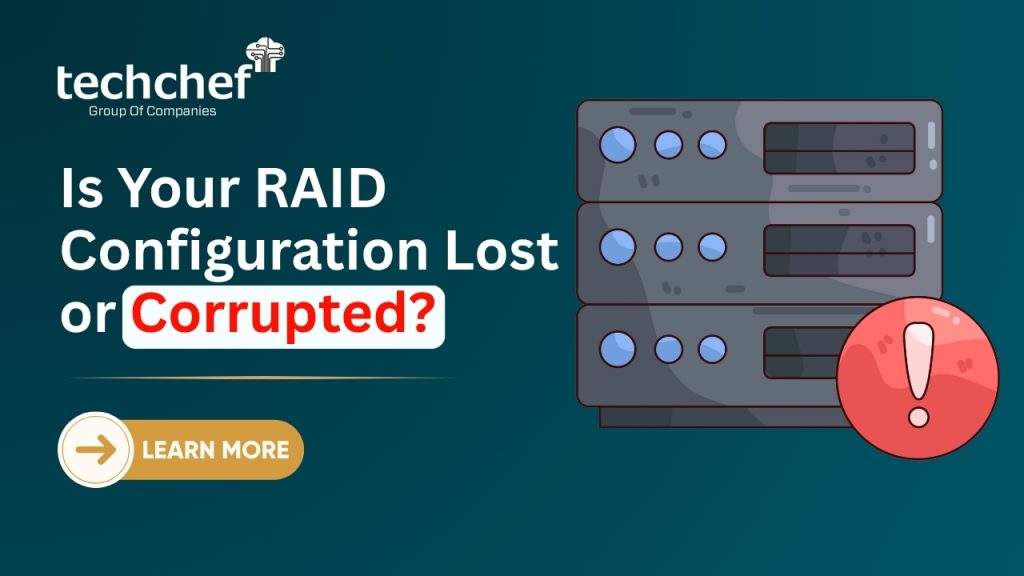
RAID Server Data Recovery in such moments feels like a lifeline. The good news is that a lost or corrupted RAID configuration does not always mean permanent data loss. Often, the drives still contain intact data; only the configuration map that tells the system how to read it has become damaged or erased. With the right approach, those configurations can be rebuilt and the data safely restored. Drawing on over three decades of experience in Server Data Recovery, RAID 5 Data Recovery, and Multiple drive failure recovery, this guide will help you understand why configurations fail, how to rebuild your RAID setup, and how professionals like Techchef Data Recovery bring lost systems back to life.
What Is a RAID Configuration and Why It Matters
Before we talk about rebuilding or recovery, it is important to understand what a RAID configuration really is and why it plays such a crucial role in keeping your data safe. Many business owners only realise the value of this configuration after it goes missing and the server suddenly becomes unreadable.
1. Understanding RAID at Its Core
RAID stands for Redundant Array of Independent Disks. It is a storage technology that combines multiple hard drives to work together as a single logical unit. This setup not only improves data reading and writing speeds but also offers redundancy so that even if one disk fails, your information remains safe. For growing organisations that rely on high-speed access and uninterrupted uptime, RAID is an essential foundation of secure storage.
Different RAID levels serve different purposes. For instance, RAID 0 Data Recovery applies to configurations designed purely for performance, where data is striped across drives without redundancy. RAID 1 mirrors your data across two drives for maximum protection. RAID 5 Data Recovery involves arrays that balance both speed and fault tolerance by distributing data and parity information across all drives. RAID 6 extends that safety net even further by allowing recovery from two simultaneous disk failures. In more complex environments, RAID 10 combines mirroring and striping to achieve both speed and reliability.
When functioning correctly, RAID systems make your work seamless. Files open faster, servers perform efficiently, and downtime is almost non-existent. But when the configuration becomes lost or corrupted, that harmony breaks and your RAID no longer knows how to interpret where each piece of data belongs.
2. What Does RAID Configuration Mean
A RAID configuration is like the recipe that defines how all the drives inside your array work together. It includes several technical parameters, such as:
✅ RAID level (0, 1, 5, 6, 10)
✅ Stripe or block size
✅ Parity distribution type
✅ Disk order and position
✅ Controller metadata and firmware version
All this information is saved as metadata on each drive and within the RAID controller. It acts as a reference that tells your system how data is distributed, how parity is calculated, and how the entire storage volume appears as one single logical unit.
If this configuration data is deleted or becomes unreadable due to a fault, your operating system cannot identify the array structure. The drives still hold all your files, but the system loses its ability to access them properly. This is where Recover data from RAID procedures become essential, requiring careful reconstruction of these parameters to restore the logical order of data.
3. Why Configuration Integrity Is Critical
Your RAID setup works perfectly only when all drives communicate based on a shared understanding of those parameters. If even one element, such as disk order or stripe size, is misread, the entire file structure becomes scrambled. Losing configuration integrity is like misplacing the index of a giant library, the books (data) are still there, but finding anything becomes impossible without the correct map.
Techchef Data Recovery experts often describe RAID configuration as the heart of the entire system. When it beats in rhythm, everything works flawlessly. But when that rhythm is broken, careful technical intervention is needed to rebuild it. As an engineer once told a client, “Your data isn’t gone, it’s just hiding behind a broken structure.” This is exactly why configuration integrity matters so deeply in every RAID Server Data Recovery case.
Common Causes of Lost or Corrupted RAID Configurations
Losing your RAID configuration can be terrifying, but understanding why it happens is the first step to recovery. Most of the time, the drives themselves are fine, it’s the RAID map that’s damaged. Here are the most common reasons, simplified:
a. Hardware Failures
Faulty RAID controllers, damaged backplanes, or interface issues can stop the array from recognizing drives. For example, a design studio in Bangalore lost their RAID 5 configuration when a power surge burned out the controller. The drives were fine, but the server showed the array as “unconfigured,” requiring professional RAID Server Data Recovery.
b. Human Errors
Manual mistakes are surprisingly common. An admin might accidentally delete a configuration while trying to rebuild or insert a replacement drive in the wrong slot. In one Mumbai-based enterprise, initializing a new array by mistake erased the RAID metadata, making the array inaccessible. Only expert Multiple drive failure recovery restored the data safely.
c. Firmware or Software Issues
Firmware corruption or interrupted updates can erase configuration metadata. Even routine OS updates or driver conflicts sometimes make the RAID appear missing. Professionals like Techchef Data Recovery recommend updating firmware only with stable power and verified versions to avoid losing the RAID map.
d. Multiple Drive Failures
RAID arrays can handle one drive failing, but two or more failing at once can corrupt the parity alignment. A financial firm experienced simultaneous failure of two RAID 5 drives due to overheating, which caused the controller to misalign parity during an auto-rebuild. RAID 5 Data Recovery in such cases requires expert analysis to reconstruct the parity manually.
e. File System Corruption and Metadata Loss
Sometimes the RAID looks lost due to file system problems, like a damaged MFT, superblock, or partition table. The OS may show drives as “foreign” or “unassigned” even if the array is physically healthy. Only a careful Server Data Recovery process can extract configuration fragments and rebuild the logical structure.
Did You Know?
Nearly 70% of RAID configuration losses are caused by firmware issues or manual configuration errors rather than complete hardware failures. That means most cases can be recovered safely, provided no one attempts a rebuild without proper cloning and analysis.
Signs That Your RAID Configuration Is Lost or Corrupted
Recognising the signs early can prevent further damage and make RAID Server Data Recovery much more successful. Look out for these indicators:
✅ RAID Not Detected – The RAID manager or BIOS fails to detect the array. Drives may be healthy individually, but the logical volume is invisible.
✅ Drives Shown as “Unassigned” or “Foreign” – Indicates that the controller cannot read the configuration metadata. Experts at Techchef Data Recovery use this symptom to start metadata extraction and virtual reconstruction.
✅ Missing or Inaccessible Logical Volumes – Logical drives or partitions disappear. Data still exists on the drives but cannot be mapped correctly.
✅ File System Errors or Unreadable Data – Frequent errors, corrupted files, or unreadable volumes often occur after a failed rebuild or incorrect drive replacement. Multiple drive failure recovery may be needed.
✅ RAID Controller Prompts to Initialize New Array – Repeated prompts to initialize risk overwriting original configuration metadata. Accepting this can make RAID 5 Data Recovery or RAID 0 Data Recovery far more difficult.
Pro Tip: At the first warning sign, stop all write operations immediately. Overwriting even a small part of the metadata can reduce the chances of a successful recovery.
First Things to Do When RAID Configuration Is Lost
When your RAID configuration disappears, acting carefully and systematically is essential. Rushing or experimenting on the live array can turn a recoverable situation into permanent data loss. Below are the most critical first steps you should follow to maximize the chances of a successful RAID Server Data Recovery.
A. Stop All Write Operations Immediately
✅ Do not attempt to boot the server, rebuild the array, or initialize drives. Even a simple reboot can overwrite the RAID metadata stored on disks.
✅ Continuing to use the array may corrupt parity information and logical structures, making recovery more complex.
✅ Real Example: A mid-sized marketing firm in Pune powered on their degraded RAID 5 array after noticing missing volumes. Within minutes, some parity data was overwritten, making professional RAID 5 Data Recovery far more complicated and time-consuming.
B. Do Not Initialize or Rebuild Right Away
✅ Initializing or forcing a rebuild can permanently erase the original configuration and overwrite existing data.
✅ until you have safely cloned all drives and documented their current state. Professionals performing Multiple drive failure recovery always insist on cloning first to avoid accidental loss.
✅ Real Example: A Hyderabad software company tried a rebuild after a controller reset. The system wrote new metadata over the existing configuration, leaving only partial data recoverable.
C. Label and Document Every Drive
✅ Record port numbers, slot positions, and LED indicators. Take clear photographs of the physical connections.
✅ Accurate documentation preserves the original order and layout, which is essential for proper virtual reconstruction.
✅ Real Example: In Mumbai, an IT team mislabeled two drives during maintenance. Even though the drives were healthy, the incorrect order initially prevented RAID 0 Data Recovery until the sequence was verified.
D. Clone the Drives Before Analysis
✅ Use professional-grade imaging tools to create bit-by-bit copies of all drives.
✅ Work only on the clones during RAID Server Data Recovery or RAID 5 Data Recovery, never on the originals. This ensures that any trial reconstructions or tests do not alter the source data.
✅ Real Example: A hospital in Chennai faced a multi-drive failure scenario. By cloning the drives first, experts were able to virtually rebuild the RAID and recover critical patient records without risking the original disks.
E. Identify the RAID Level and Controller Health
✅ Determine the RAID type (0, 1, 5, 6, 10) using server logs, past IT documentation, or RAID management tools.
✅ Verify the controller firmware is healthy. Replace it with an identical model if corrupted, keeping the firmware version consistent.
✅ Real Example: A Delhi-based law firm’s RAID 6 server lost configuration after a firmware crash. Identifying the exact RAID level and matching controller firmware allowed successful Server Data Recovery without additional drive failures.
Did You Know?
Around 65% of RAID configuration losses could have been prevented with proper documentation and drive cloning before attempting any rebuild. Taking these first careful steps significantly increases the success rate of professional Techchef Data Recovery operations.
Step-by-Step Guide to Rebuild and Recover RAID Configuration
Recovering a lost or corrupted RAID configuration is a delicate process. With the right approach, even complex arrays like RAID 5, RAID 6, or RAID 10 can be rebuilt safely. Below is a structured, step-by-step guide for RAID Server Data Recovery.
1. Assess the RAID Controller and Drives
✅ Check whether the controller retains any partial configuration or metadata.
✅ Inspect drives for connectivity and health. Ensure there are no loose cables or physical damage.
✅ Real Example: A software firm in Bangalore had a RAID 5 array showing all drives as “foreign.” By checking the controller, recovery engineers discovered partial metadata, which became the starting point for successful RAID 5 Data Recovery.
2. Retrieve Metadata from Each Drive
✅ Each RAID member contains fragments of configuration data.
✅ Use professional tools to extract metadata from every drive. This includes stripe size, parity rotation, and disk order.
✅ Real Example: In a Delhi data centre, extracting metadata from eight drives allowed the team to virtually reconstruct the RAID without touching the original disks, ensuring complete safety during Multiple drive failure recovery.
3. Identify Key RAID Parameters
✅ Determine RAID type (0, 5, 6, 10), block size, parity rotation, and drive sequence.
✅ Confirm disk order using parity analysis; even a single misplacement can render the array unreadable.
✅ Real Example: A Mumbai media company’s RAID 10 array appeared offline after a failed firmware update. Correctly identifying stripe size and parity rotation allowed full Server Data Recovery.
4. Virtual Reconstruction of RAID
✅ Combine the cloned drives into a virtual RAID using extracted parameters.
✅ Rebuild logically, not physically, to avoid altering the original drives.
✅ Validate the virtual array by previewing file structures and checking known file headers.
✅ Real Example: A hospital in Chennai recovered patient data from a RAID 6 array by rebuilding it virtually first, ensuring all critical files remained intact.
5. Repair Logical Structure
✅ Check the file system (NTFS, EXT, XFS, HFS) for corruption.
✅ Reconstruct partition tables, MFT, superblocks, or inodes as needed.
✅ Real Example: A law firm in Delhi faced unreadable partitions after a RAID controller crash. File system repair after virtual reconstruction restored access to 98% of their legal databases.
6. Recover and Verify Data
✅ Extract recovered files to a separate, secure storage device.
✅ Verify file integrity, including large databases, virtual machines, and critical documents.
✅ Use checksum or hash verification to ensure consistency.
✅ Real Example: A Bangalore financial company recovered their SQL databases and VM images after virtual RAID reconstruction, all verified for accuracy before going live.
7. Backup and Validate Rebuilt Configuration
✅ Once verified, document the rebuilt RAID structure thoroughly.
✅ Save the configuration file for future reference and avoid repeated emergencies.
✅ Real Example: After rebuilding a RAID 5 array for a media firm, engineers exported the configuration. Later, a minor drive replacement did not require a full recovery because the saved configuration could be restored immediately.
Expert Insight:
In most cases, the data still exists on the drives, it’s the configuration that goes missing. The key to success in RAID Server Data Recovery lies in accurately rebuilding this “blueprint” and never working directly on the original disks until clones are safely verified.
Case Study: Rebuilding a Corrupted RAID 5 Configuration
In real-world RAID Server Data Recovery, each case teaches valuable lessons. Here’s a detailed example from a data center in Mumbai that faced a challenging RAID 5 failure.
Scenario:
A data center hosting critical client files experienced a sudden RAID 5 failure in an 8-drive array. The RAID controller had unexpectedly reset during a routine firmware update. All drives were shown as “foreign,” and the logical volume disappeared. Panic quickly spread among the IT team because the array contained client contracts, financial data, and project files spanning several years.
Step-by-Step Recovery Approach:
1. Cloning Drives: All eight drives were cloned immediately to preserve the original data. This ensured that no further operations risked overwriting the RAID metadata.
2. Metadata Extraction: Each drive was carefully analyzed to retrieve parity information, block size, and drive order. These fragments provided the map to reconstruct the array virtually.
3. Virtual RAID Reconstruction: Using professional tools, the RAID was rebuilt in a virtual environment. The engineers tested different parity rotations and confirmed correct stripe alignment by previewing known file headers.
4. File System Repair: The NTFS file system showed some corruption in the Master File Table. Engineers repaired it using controlled tools to ensure all client files and databases were accessible.
5. Data Verification and Export: Once the RAID was reconstructed, all files were exported to a separate secure storage device. Databases, large project files, and spreadsheets were verified using checksums and hashes for integrity.
Outcome:
✅ 99% of the data was successfully recovered, including mission-critical SQL databases and multimedia files.
✅ The data center restored services within 48 hours, preventing prolonged downtime for clients.
✅ Engineers documented the rebuilt RAID configuration, creating a blueprint for future emergencies.
Lesson Learned:
✅ Quick, calm action is essential.
✅ Proper drive cloning and virtual reconstruction are far safer than attempting rebuilds on live arrays.
✅ Professional RAID Server Data Recovery expertise can turn seemingly hopeless situations into full recovery successes.
Pro Tip:
Even when all drives appear “foreign” or the controller fails completely, accurate metadata analysis and virtual reconstruction allow recovery. In most cases, the data itself is safe it’s the configuration that needs expert handling.
Mistakes to Avoid During RAID Rebuild or Recovery
Recovering a RAID configuration can be stressful, and hasty decisions often lead to permanent data loss. Here are the most common mistakes to avoid when performing RAID Server Data Recovery
✅ Attempting Rebuilds on Live Disks
Rebuilding without cloning can overwrite metadata and parity, making full recovery impossible.
✅ Reinitializing the Array Prematurely
Initializing before documenting or cloning destroys original configuration data.
✅ Mixing Drives from Different Arrays
Even a single misplaced drive can make RAID 0 Data Recovery or RAID 5 Data Recovery extremely difficult.
✅ Using Generic Recovery Tools Without RAID Awareness
Free or standard recovery software may not understand parity or striping patterns, leading to corrupt files.
✅ Replacing Multiple Drives Simultaneously Without Testing
Replacing several drives without checking each one increases the risk of incorrect reconstruction and failed recovery.
Quick Reminder:
Even small mistakes, like incorrect stripe size, block size, or disk order, can make a RAID unrecoverable. Always work systematically, clone drives first, and consult professionals if you are unsure.
Did You Know?
Studies show that over 60% of failed RAID recoveries are caused by human error during attempted rebuilds, not by the initial drive failure itself. Careful, step-by-step action is often the difference between full recovery and permanent data loss.
When to Seek Professional RAID Data Recovery Help
Knowing when to call in experts can make the difference between recovering your critical data and facing permanent loss. If multiple drives are physically damaged, the RAID metadata is completely corrupted, or the controller has burned out, attempting DIY recovery can worsen the situation. Even seemingly minor issues, like unknown parity rotation or disk order, require precise expertise to safely rebuild the array.
Professional services like Techchef Data Recovery have the tools and experience to handle these complex scenarios. They begin by creating exact clones of all affected drives to preserve the original data. Using specialized hardware and software, they analyze parity structures, extract RAID metadata, and virtually reconstruct the array without touching the original disks. Once the virtual RAID is confirmed, they repair file systems, rebuild partitions, and verify data integrity before returning it to the client.
Conclusion
Losing or corrupting a RAID configuration can feel like a disaster, but it does not always mean permanent data loss. With careful, methodical action, even complex arrays like RAID 5, RAID 6, or RAID 10 can be successfully rebuilt. The key is to stop all write operations immediately, clone drives, and analyze the metadata carefully before attempting any rebuild. Professional help ensures the process is safe and precise and maximizes the chance of full recovery.
For immediate assistance, call now at 1800-313-1737 or visit our website www.techchef.in to connect with our expert recovery team. Your data deserves the best chance of recovery—don’t wait until it’s too late.
FAQs
Q1. Can I recover data if the RAID configuration file is missing?
Yes. Even if the configuration is gone, professional services like Techchef Data Recovery can rebuild the array manually by analyzing parity, striping patterns, and metadata from each drive.
Q2. Is it safe to import a ‘foreign configuration’ in the RAID manager?
Only if you are certain it matches the original array parameters. Otherwise, importing a foreign configuration may overwrite crucial data and make recovery more difficult.
Q3. What happens if I reinitialize my RAID array?
Reinitializing erases the original metadata and can destroy the RAID configuration. This makes RAID Server Data Recovery far more complicated and risky.
Q4. Can software-only recovery fix corrupted RAID configurations?
In some minor cases, yes. However, for complex situations like multi-drive failures or lost metadata, physical cloning and expert analysis provide far higher success rates.
Q5. How long does RAID configuration recovery usually take?
Recovery times vary depending on the number of drives, the type of RAID, and the extent of corruption. It can take anywhere from 24 hours for smaller arrays to several days for enterprise-level setups.