If you’d told me ten years ago that artificial intelligence would one day help predict a hard drive’s death before it happened, I’d have laughed and gone back to my magnetic head replacements. But here we are in 2026, and AI has quietly become one of the most useful tools in a data recovery engineer’s kit. Not a gimmick, not a marketing buzzword — an actual working part of how we rescue your files today.
I’ve spent years elbow-deep in failed drives, corrupted RAID arrays, and dead SSDs, and I can tell you this: the biggest shift I’ve seen recently isn’t in the hardware. It’s in how smart the software around that hardware has become. Let me walk you through what’s actually changing, and why it matters to you.
Why This Shift Is Happening Now
Data loss isn’t a rare event anymore — it’s a daily reality for millions of people and businesses. We’re generating data faster than ever: 4K and 8K video, massive databases, endless cloud backups, IoT logs, CCTV footage running 24/7. More data sitting on more devices simply means more chances for something to go wrong.
At the same time, storage technology has gotten more complex. SSDs don’t fail the way old spinning hard drives did. NAND flash wears out unevenly, controllers behave unpredictably, and by the time you notice a problem, the damage is often already done. Traditional recovery methods, built around HDDs, just weren’t designed for this kind of complexity.
That gap between growing demand for reliable recovery and the limited supply of engineers who can keep up with modern storage complexity is exactly where AI has stepped in. There simply aren’t enough experienced hands to manually sift through every failing drive line by line anymore — and AI helps close that gap without cutting corners on quality.
Where AI Is Actually Making a Difference
Let’s get specific, because “AI in data recovery” can sound vague if you don’t know what’s happening under the hood.
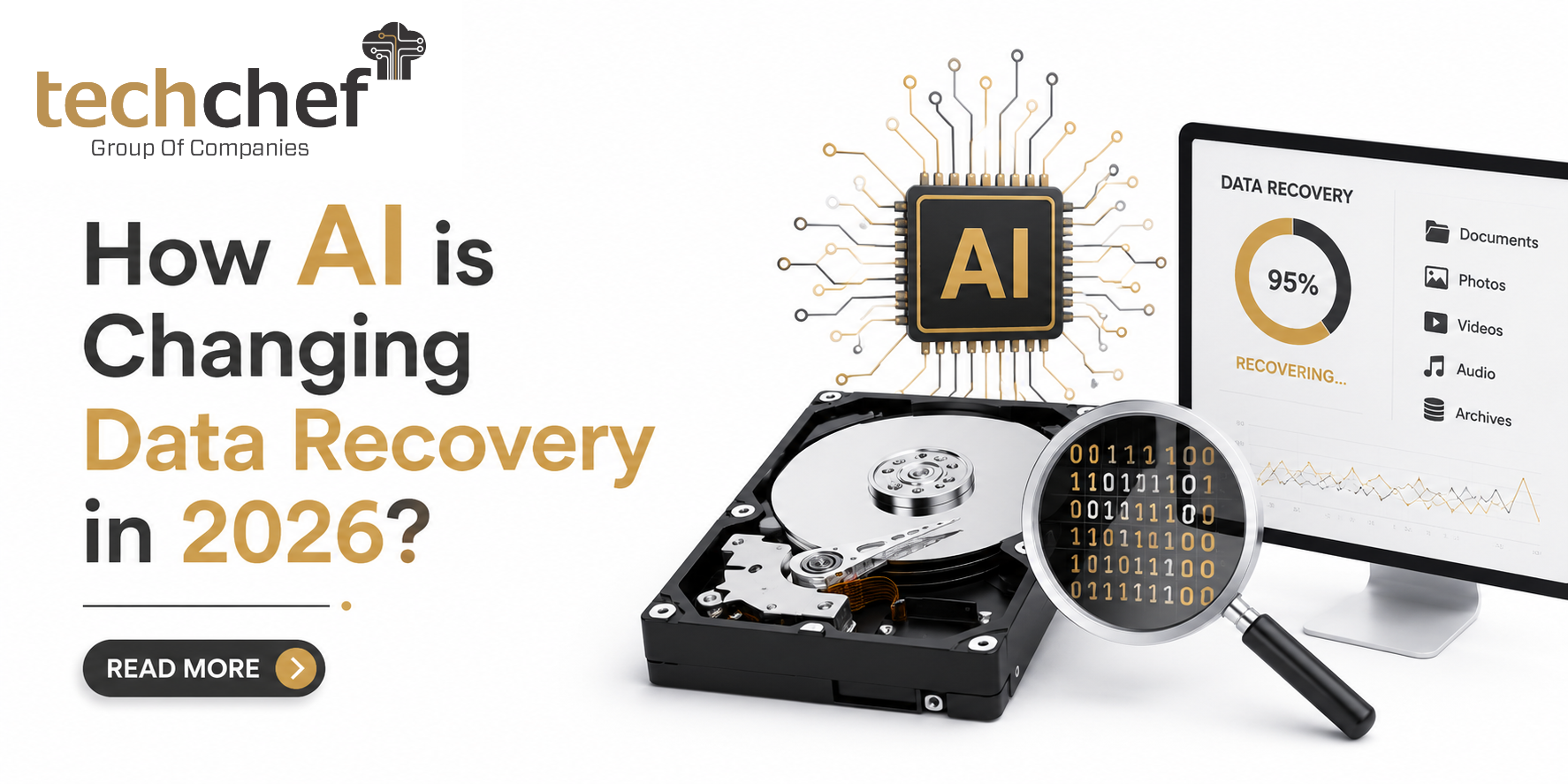
🡲 Predictive failure detection. Modern monitoring tools now analyze SMART data, temperature patterns, and read/write anomalies in real time. Instead of waiting for a drive to die, AI models flag early warning signs — unusual bad sector growth, inconsistent spin-up times, firmware irregularities — often days or weeks before a total failure. That early warning can be the difference between a simple backup and a full recovery job.
🡲 Smarter file reconstruction. When files get fragmented or corrupted, older recovery software worked off rigid file-signature templates. AI-assisted tools now recognize partial patterns and reconstruct file structures even when headers are damaged, which noticeably improves recovery rates for photos, videos, and documents that used to be written off as unrecoverable.
🡲 Faster triage on complex cases. RAID arrays and NAS systems used to take our engineers hours just to map out drive order, stripe size, and parity configuration. AI-assisted diagnostic tools now crunch through that analysis in a fraction of the time, so our engineers can focus their expertise where it really matters — the delicate physical and logical recovery work.
🡲 Ransomware and cyberattack response. This is a big one. AI-driven anomaly detection can spot the tell-tale signs of ransomware encryption in progress and, in some cases, help isolate unaffected data before it’s touched. Combined with immutable backup strategies, this is reshaping how businesses recover from cyberattacks.
Did You Know?
Nearly half of all businesses have experienced at least one major data breach or loss incident in just the past two years, and a growing share now rely on AI-driven tools somewhere in their backup or recovery process. That’s not a distant future trend — that’s happening right now, across industries of every size.
A Real-World Example: Banking
Let me share a scenario that shows why this matters beyond just convenience.
A mid-sized regional bank we worked with experienced a sudden RAID controller failure on one of their transaction servers during a routine firmware update. Two drives in a five-disk array dropped out almost simultaneously — every recovery engineer’s nightmare, because a RAID isn’t just “one drive,” it’s an interlocking puzzle. With customer transaction records, KYC documents, and compliance logs on the line, there was zero room for guesswork or trial and error.
Using AI-assisted RAID mapping, our team was able to rapidly reconstruct the correct drive order and stripe configuration — a process that would normally take considerable manual analysis — and cross-check it against partial metadata patterns the software flagged as consistent with the original array. That sped up the diagnostic phase significantly, letting our engineers move straight into careful sector-level imaging and reconstruction. The bank got its transaction data back intact, with full audit trail integrity preserved, well within the compliance window they were racing against.
That’s the real value of AI here — it’s not replacing skilled engineers, it’s giving them better tools to work faster and smarter under pressure, especially in industries like banking where every hour of downtime carries real financial and regulatory weight.
AI Isn’t a Replacement — It’s a Force Multiplier
I want to be honest with you about something: no AI model is opening up a physically damaged drive in a cleanroom and swapping a read/write head. That’s still precision, hands-on work that takes years to master. What AI does is handle the heavy analytical lifting — pattern recognition, predictive alerts, and rapid diagnostics — so our experienced engineers can spend their time where human judgment truly matters.
This balance is exactly how we approach things. We use AI-assisted diagnostics to speed up analysis and improve accuracy on complex cases, but every recovery is still guided, reviewed, and executed by real engineers who understand the nuances a machine simply can’t.
Final Thoughts
AI has genuinely changed what’s possible in data recovery — faster diagnostics, better reconstruction rates, and earlier warnings before disaster strikes. But at the end of the day, recovering your lost data still comes down to expertise, precision equipment, and a lab environment built for the job.
That’s where Techchef Data Recovery comes in.
We combine modern AI-assisted diagnostic tools with genuine hands-on expertise to recover data from SSDs, HDDs, CCTV systems, and complex RAID servers — including devices that are physically damaged, broken, or water-affected. Our work happens inside an ISO-certified lab with dedicated cleanroom facilities, handled by experienced data recovery engineers and technicians who’ve seen just about every failure scenario there is.
If you’re dealing with a failed drive, a corrupted RAID array, or a device that just won’t turn on, don’t wait for the problem to get worse.
- Visit our website to learn more about our recovery services
- Book a free pickup & drop service and let us handle the logistics
- Schedule an appointment with one of our recovery specialists
- Call our toll-free number 1800-313-1737 for immediate assistance
Your data matters — and with the right blend of technology and expertise, more of it is recoverable than you might think.